A Zenith Shirt Pocket Radio, and the experience of hearing something for the first time.
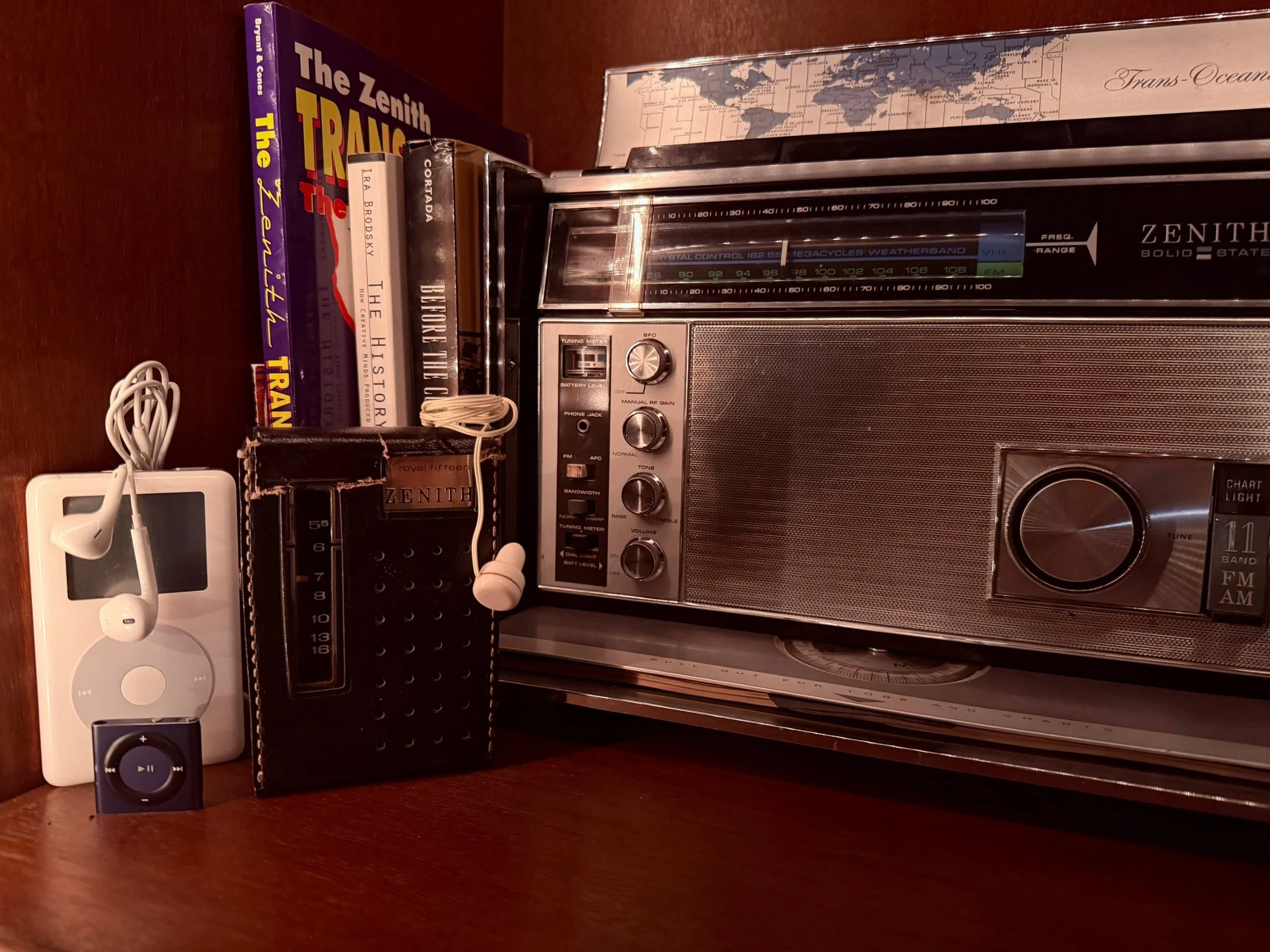
An old Zenith transistor radio sits in a cabinet in my office, alongside a number of things I've collected over the years. I found it in an antique shop some years ago. It has a worn leather case, a tuning dial, and a small earpiece. Beside it are several generations of iPods, objects I placed there deliberately, though I suspect my reasons for keeping them together have shifted over time.
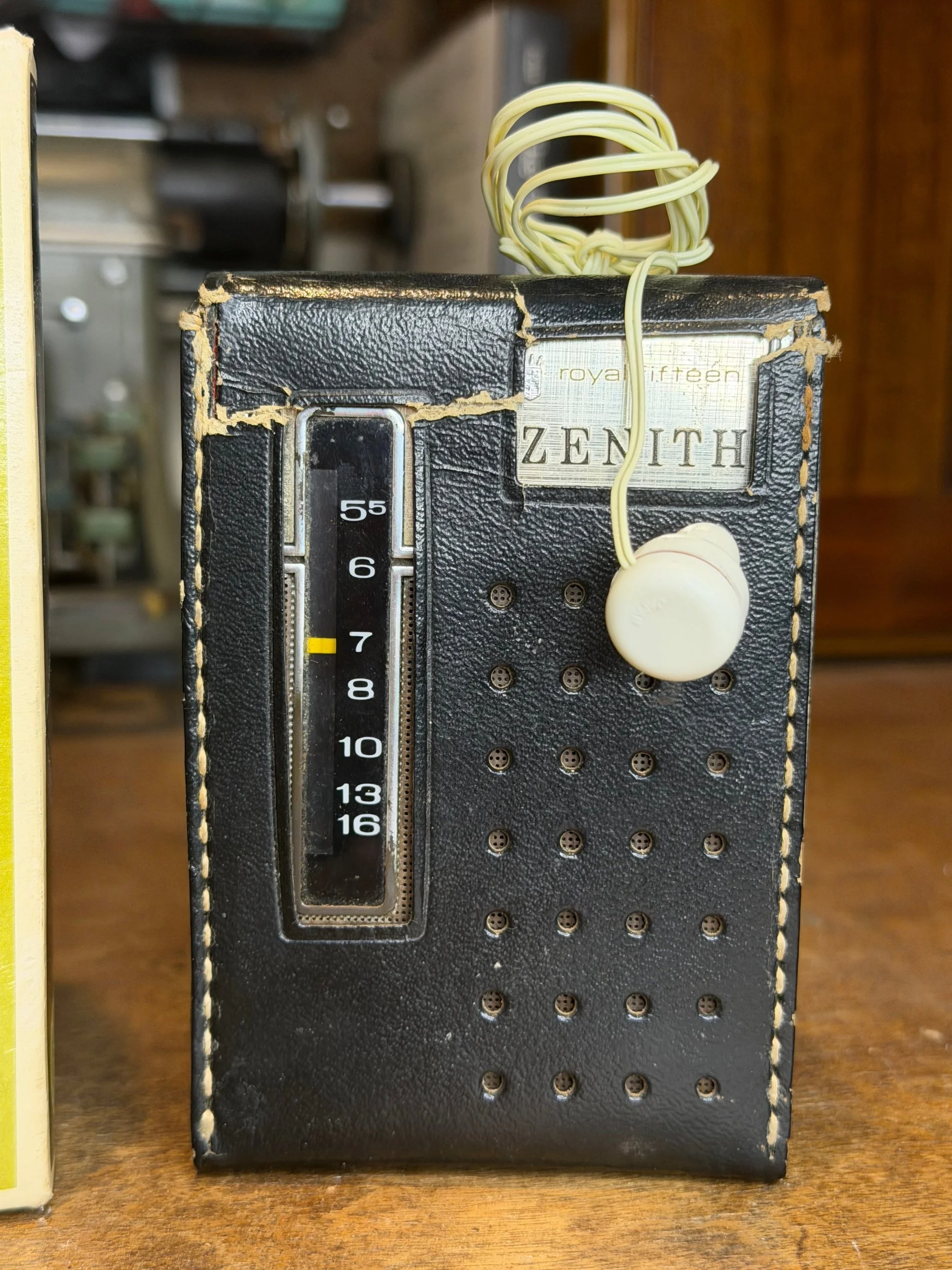
My father grew up in Philadelphia in the 1940s and 1950s, when radios were still substantial pieces of household furniture. Some were beautiful wooden cabinets that occupied a prominent place in the living room. Families gathered around them to listen to music, news, and broadcasts from places they might never visit. Radio had already transformed everyday life, bringing voices and events from across the world into people's homes. But listening was still, for the most part, organized around the machine itself; you went to the radio.
By the time my father was a young man, an extraordinary change was underway, originating in work conducted a few years earlier at Bell Telephone Laboratories in New Jersey. In December 1947, John Bardeen and Walter Brattain demonstrated a semiconductor device that could amplify electrical signals without the bulky vacuum tubes on which electronics had long depended. William Shockley, who led the research group, would go on to develop the junction transistor. All three would eventually share the Nobel Prize.
The transistor was one of the great achievements of solid-state physics, but its importance extended far beyond the laboratory. Electronic devices could become smaller, consume less power, and operate more reliably. Their eventual mass production would make electronic capabilities available on a scale that had previously been impractical.
There was something remarkable about the intellectual environment in which this happened. At Bell Labs, Claude Shannon was working on a different problem entirely. His 1948 paper, A Mathematical Theory of Communication, established the foundations of information theory, demonstrating that information could be described and quantified mathematically, independent of the meaning of the messages being transmitted. Shannon's work and the transistor were distinct achievements, but they emerged almost simultaneously from the same institution. The mathematical understanding of information and the physical means of processing and transmitting it would eventually converge in technologies that neither development alone could have made possible.
It took only a few years for the transistor to begin changing ordinary life; hearing aids, for example, became smaller and more practical. In 1954, the Regency TR-1 introduced Americans to the first commercially available transistor radio. Manufacturers like Zenith soon followed, producing battery-powered radios small enough to carry in a pocket. Portable radios had existed before, but the transistor made portability practical in an entirely new way. Music, which had once required a family gathering around a cabinet in the living room, could now accompany an individual through the day.
My father was a teenager during those years, and he remembered the change vividly. He told me more than once what a luxury a transistor radio had been, and how extraordinary it seemed that you could take one wherever you wanted. He had owned a Zenith much like the one I would eventually find in the antique shop. I don't know whether he bought his himself or received it as a gift, and I never thought to ask. What I remember most clearly from those conversations was his fascination with the earpiece. People could still gather around the little radio and listen together, just as they had around its larger predecessors, but the earpiece allowed something quite different. You could sit among other people, walk down a street, or travel somewhere, listening to music that no one around you could hear.
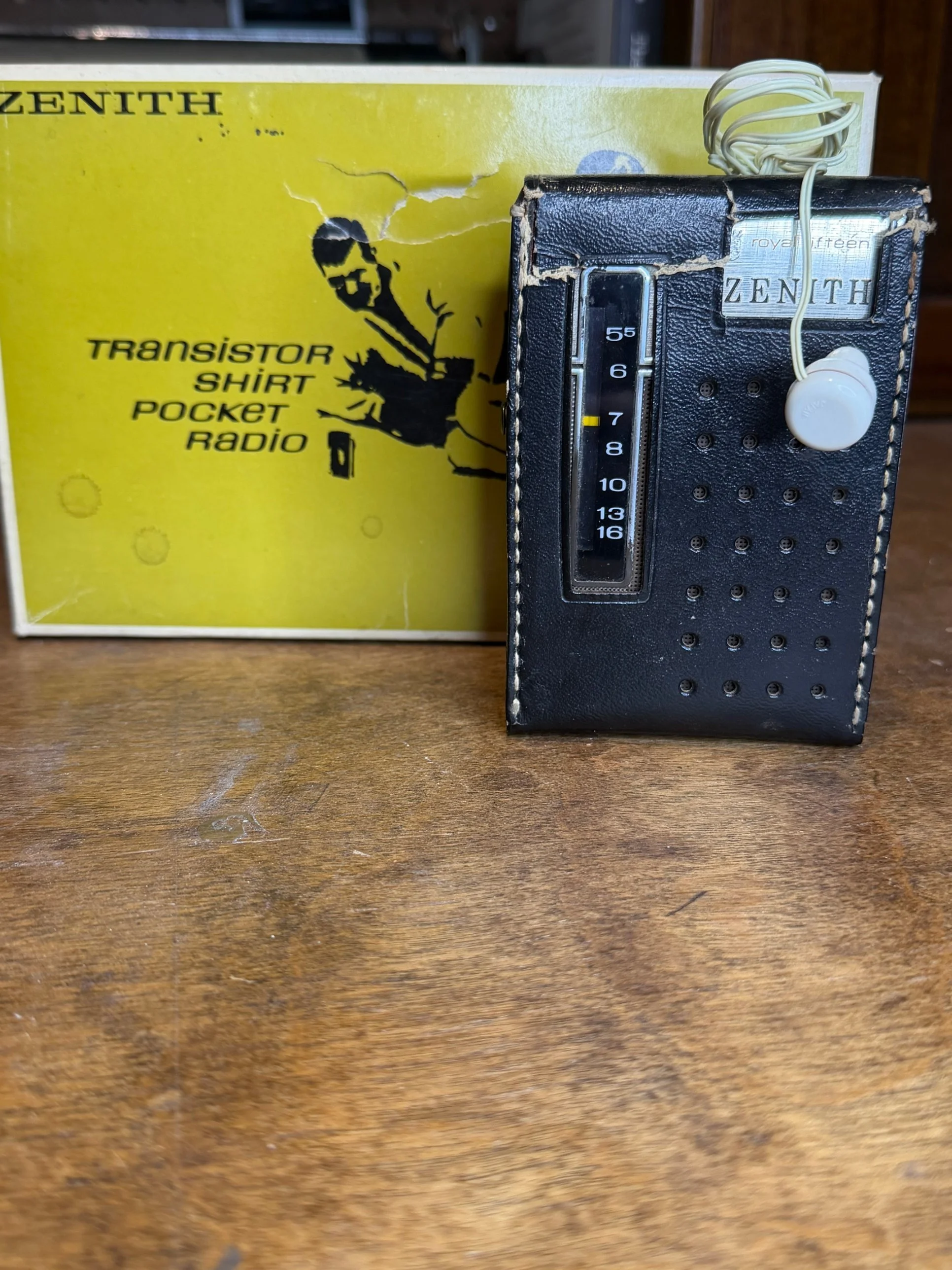
It's an experience so familiar now that recovering its original novelty requires real effort. I've spent much of my life making that effort, drawn to old photographs, historical accounts, and the objects people once held, trying to imagine a world before the things we now take for granted existed. Not simply what was different, but what it felt like to live through the change. The Walkman would eventually make private, portable listening commonplace, and decades later the iPod would place a personally curated library of thousands of songs in a device smaller than the Zenith in my cabinet. Today, we have access to almost any recorded music without a second thought.
I've always been fascinated by that progression, not particularly by the individual circuits or components, but by the way technologies emerge from human imagination and reshape what it means to be human. A radio that could fit in a pocket wasn't simply a smaller version of a living-room appliance; it made different behaviors possible, and over time those behaviors became expectations. The relationship between people and music changed, as did the relationship between listening and the world around us.
Some years ago, my father was visiting us in Concord. He was in his mid-seventies, and we were standing together in my office when he noticed the Zenith in the cabinet. He grinned, I think that seeing it there brought back the memories of his radio and what it had meant to own one.
I remember looking over at him as he stood there, smiling at that little radio from another era. There was something in his expression, a pleasure and recognition that seemed to belong to a much younger man. I was looking at my father, now in his mid-seventies, yet for one fleeting instant I had the sensation that I was seeing the boy he'd been sixty years earlier.
The details of the past have always mattered to me because they bring me closer to experiences I cannot otherwise recover. I want to know what the world looked like to people living in it, before the events we now regard as history had acquired their familiar meanings. Standing beside my father that day, I felt I'd briefly crossed some of that distance. I couldn't know exactly what he'd thought when he first received his radio, or what music he listened to, or where he took it. But looking at his face, I thought there was a very good chance I was seeing something of the expression he'd worn when he first held one. Whatever he remembered in that moment, something of the original wonder seemed still to be there.
My father died last year. Since then, I've written a book trying to understand his life, particularly the years before I knew him. There were photographs I'd never seen, stories I'd heard but never fully understood, and questions I wish I'd known to ask while he was alive.
The Zenith remains in my office, beside the iPods, a small part of the much larger history of how electronics changed our world. I still find that history remarkable, but when I look at the radio now, I also remember standing beside my father and, for perhaps a second, seeing in his face something of the boy who first discovered what it meant to carry music with him.
I cannot return to that world, any more than I can return to that afternoon with him. But I remember the look.