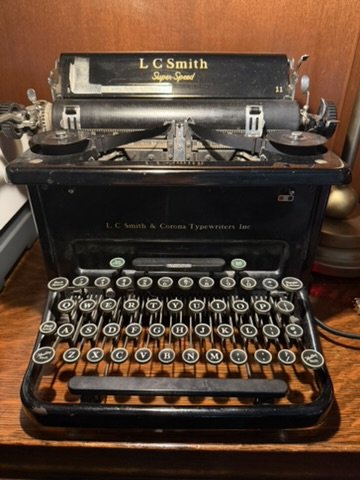
I bought my first typewriter just after I moved to Nyack, NY, around 2010. I was in Hyde Park, a small town about an hour north on the east side of the Hudson, where FDR’s house is located. I had stopped at one of the many antique stores along the highway north from Tarrytown. I wasn’t looking for anything in particular. On the floor was this enormous black L C Smith Super Speed. I had no special knowledge of typewriters then, and I knew nothing about this specific machine. I paid $100 for it, dropped it into the back of my truck, and headed home.
Here is one thing about me: things like this tend to spark some compulsion to know about the thing in as much detail as I can find and absorb. When was this made? How many of them? What did they cost? Why did people buy them? I feel as if I am having a conversation with the past, using the thing in front of me as my access and my bona fides, and that somehow, if I sit with the thing and the information long enough, I can get a glimpse of a world that no longer exists.
It was made in the 1930s, weighs about 35 pounds, nearly all of it iron and steel, and was built for fast, continuous writing in offices and newsrooms.
I cleaned up the machine, bought a ribbon for it, and it sat on the corner of my desk next to my modern equipment. I enjoyed looking at it. Imagining someone using that machine when it was new helped to settle my thoughts, and to recognize that my very modern obsession with speed and technology was the same for the imaginary person who owned my typewriter. But how different our perspectives on what those words mean!
This was the state of affairs until my children, then very young, began to play with it. They loved it: the sound of the type bars hitting the platen, and the immediate satisfaction of seeing the letter on the paper.
It was in that context that I found my second typewriter. I will not write about that machine in any depth here, except to note that it was from the 1930s, black and red and simply gorgeous. It had been in its case for almost 70 years, untouched. Of course I went home and immersed myself in the same conversation with the past, but that second time was different.
I was born in 1970, and during my middle and high school years, the transition from electric typewriters to hybrid typewriter-word processors to stand-alone word processing software was underway. What struck me, sitting with that 1934 Corona in front of me, was that in the span of about 20 years, typewriters essentially disappeared from use. If a version of me could travel back to 1934 and tell the buyer of that machine that in less than 50 years we would have machines we could type on, but on which we could also delete a letter, a sentence, or a paragraph and simply rewrite it, what would that person have said to me? The acts of thinking, writing, and editing had been merged into what I knew as typing.
I keep the L C Smith Super Speed separate from all my other machines. It remains special to me. It was where I first understood the necessary counterforce, like Newton’s law, that technology exerts on us, changing us in return. I can strike those keys and make letters appear on a page, but I cannot type in the manner the people who once bought those machines could. Even the word type means something different to me than it did to them.
That gap has been an endless source of fascination and exploration for me ever since.