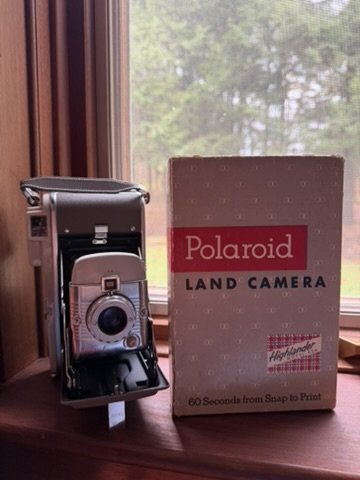
It was a beautiful fall Sunday in Concord. I rode my bike into town to trifle the day away a little, went into one antique store, then another. On a shelf to the left of the front door sat a Polaroid Highlander, the Model 80, a folding camera from the 1950s. The camera was out, and beside it sat its case with everything still inside. I stood there with it in my hands and looked it up on my phone. The first thing I found was this article by Lexi Gerdts on the early roll-film Land cameras, and I read it standing just inside the door.
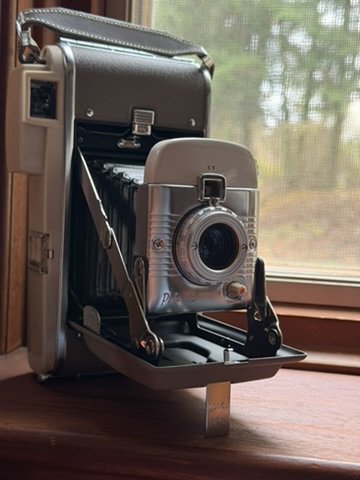
I didn’t need another camera. I already had a Land Camera 900, several 35mm bodies, and other formats going back to the 1930s. What captivated me was something simpler than the object: the distance between taking a picture and seeing it.
For a century, photography had meant waiting. You exposed the film, carried it somewhere, handed it to someone, and came back days later to learn what you had actually seen. Edwin Land closed that gap to about a minute. The machinery that did it was wondrous and clunky: steel, brass, rollers, pods of chemistry squeezed across a negative inside the camera. But the change itself was small. Snap, then view.
That small change altered everything that came after it, and it is hard now to feel how strange it once was. When my son was six or seven, he found my old PowerBook 520, the machine I wrote my PhD thesis on around 1996. It looked enough like a laptop that he expected to understand it, and almost nothing about it made sense to him. It had a power button. The screen was thick and showed only shades of gray. There was a port where a cable brought in the internet, and a slot for floppy disks. How do you explain a floppy disk? That your work lived on a square of plastic you carried in your pocket and could lose. That the little Save icon he had clicked all his life was a picture of one, an object he had never seen. He couldn’t understand that a computer could simply be off, or that the internet had once come through a wire. Later he watched Stranger Things, set in the 1980s, where the kids are exactly the age I would have been in that same year, and he was struck again by the time it took a letter to arrive, by telephones, by the waiting.
He has never waited to see a photograph. He has never wondered whether a picture came out, or opened an envelope of prints a week later to find that the moment he was sure he had kept was blurred, or dark, or simply not there.
For almost all of human history, a moment was gone the instant it happened. You carried it in memory, imperfectly, and that was all. Then for a hundred years you could keep it, but only later: days later, in an envelope, handed across a counter by a stranger. Then a man in Cambridge put the darkroom inside the camera.
Can you imagine seeing it for the first time? You count to sixty. You open the door at the back and peel the print away, and there is the face of someone who has not yet moved from where they stood.
Every phone in every pocket descends from that minute. My son lives inside it and has never had reason to notice.
The Highlander can’t do any of it now. The film hasn’t been made in decades. But holding it, you can still feel the moment the wait collapsed.